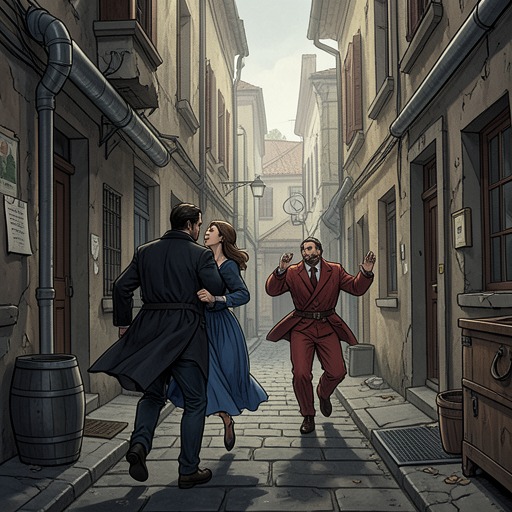
Todd Hewitt and Aaron: pursuit, fear, and hostility
The Knife of Never Letting GoTodd Hewitt and Aaron’s relationship turns a pursuit into a test of whether Todd will accept the violence Aaron presents as necessary. Aaron treats Todd as both a target and a figure in his religious vision, while Todd comes to understand that Aaron’s private aggression is tied to the persecution shaping Prentisstown and the wider New World. Their conflict reaches its sharpest point when Todd can kill Aaron but chooses not to.
The pursuer and his intended sacrifice
Aaron first appears in the evidence as an abrupt physical threat: he rises from the grass, strikes Todd, and leaves him on the ground while Manchee runs off. His Noise carries fragments of scripture, preaching, and images of a sacrifice. That mixture makes the encounter more than a fight over escape. Aaron is already placing Todd inside a story of religious purpose, and his familiar claim that one person’s fall brings everyone down gives the violence a language of communal obligation.
The language does not soften Aaron’s conduct. His smiling address to Todd accompanies an assault, and his appeal to what Todd should have learned in church is used to assert control, not to offer guidance. The gap between the preacher’s principle of shared fate and his treatment of Todd is central to their relationship: Aaron invokes unity while making another person an object in his plan.
Recognition beneath the pursuit
After Todd survives an encounter with a crocodile, Aaron catches him again. Todd had been occupied with the immediate danger and with Manchee’s barking; Aaron’s sudden appearance turns relief into renewed confrontation. Aaron tells Todd that he must go back because there are things he needs to see. Todd reads the fragments in Aaron’s Noise and answers with an accusation: the people who came after him had been sent by Aaron, who had used the quiet in his own Noise to direct them toward Todd.
This recognition changes the shape of their conflict. Todd is no longer simply trying to escape a pursuer whose actions are difficult to understand. He identifies Aaron as someone who has manipulated what others hear and who has helped make Todd a target. Aaron’s response, that smart boys make useless men, reinforces the coercive logic between them: Todd’s ability to reason and speak threatens the role Aaron is trying to impose on him. Todd keeps hold of his knife, and Aaron notices it only after its presence registers in Todd’s Noise; the threat of further violence then remains immediate.
The attack on Viola and Todd’s choice
Aaron later catches Todd and Viola as they are trying to flee. Todd has just told Viola to get up and move, but Aaron reaches them before they can escape. He attacks Todd and pins him against a tree, preventing him from using his knife effectively. When Viola’s screams draw Todd’s attention, Aaron has taken her into shallow water and seized her wrists while she struggles to get free.
Todd follows them with Manchee, despite his difficulty breathing and his uncertainty about what he can do. Aaron’s Noise overwhelms the scene with religious images: Viola appears in it as a participant in a sacrament, then as an angel, and finally as a sacrifice. Todd understands that Aaron intends to kill her. The danger to Viola makes the conflict an immediate moral crisis: Todd believes he may have to kill Aaron to stop him, but raising the knife does not make the decision easy.
When Todd loses his knife, he finds a rock in the water and strikes Aaron with it repeatedly. Aaron falls unconscious, and Todd sees that he could finish the killing. Todd’s reasoning includes what Aaron has done to him and Viola, as well as the harms he associates with Aaron’s actions against Ben and Cillian and with the trouble brought to the farm. Yet Todd cannot bring the knife down. He sees a knife as a decision made permanent in the world, not merely a tool, and refuses to make that final choice even while believing Aaron deserves death.
Todd instead tells Viola they must leave. She follows him and Manchee after he urges her again, and the three move away from Aaron into the swamp. Todd and Viola recover his rucksack and put distance between themselves and the place where Aaron lies. The outcome in this episode is not a reconciliation or a resolution of their pursuit: Aaron remains a threat left behind, while Todd’s refusal to kill him establishes a limit on the violence he will choose.
Shared responsibility and the wider conflict
The later account of New World’s history gives Aaron’s hostility a broader context. Ben explains that hardship, failing crops, sickness, and lack of prosperity were followed by preaching that blamed the Spackle. That rhetoric became a movement and then a war, in which humans had guns and the Spackle did not. Todd acknowledges the shame of that history, and Ben confirms that the human victory drove the surviving Spackle away from men.
Todd then states that, after the killing of the Spackle, the men of Prentisstown killed the town’s women. Ben says that many men were swayed by Mayor Prentiss and Aaron’s preaching, including Aaron’s claim that what was hidden must be evil; women and the men who tried to protect them were killed. This account locates Aaron within an alliance of religious incitement and political power. His pursuit of Todd and Viola is therefore connected to a pattern in which a group’s fears are directed against vulnerable targets and violence is justified as a common cause.
The same pattern appears in Prentisstown’s coming-of-age killings, which Todd learns were not isolated disappearances or suicides. Men were killed by boys on their thirteenth birthdays, sometimes after the Mayor arranged a captive victim and sometimes by falsely claiming that a disliked townsman had disappeared. Todd describes the community as complicit and guilty, while distinguishing himself from it. The evidence ties Aaron to the preaching that helped license collective violence, but does not make him the sole author of every killing or establish his role in each individual rite.
The relationship’s significance
Aaron tries to make violence seem inevitable by casting it as sacrifice, religious duty, or the price of protecting a community. Todd is repeatedly exposed to that pressure: first as Aaron’s target, then as the person Aaron expects to accept the logic of a knife, and finally as Viola’s defender. His decision not to kill Aaron does not erase the threat or excuse the harm. Instead, it marks a difference between resisting Aaron and becoming an agent of the same irreversible violence.
Their relationship thus joins a personal chase to Prentisstown’s history of scapegoating and enforced complicity. Aaron acts on an ideology that turns fear into permission to harm; Todd discovers its reach and still makes a choice Aaron cannot dictate. The conflict remains unresolved when Todd leaves Aaron in the swamp, but its moral direction is clear: escape requires protecting Viola, while refusing to let Aaron’s violence decide what kind of person Todd becomes.